? Are we getting the raw power and comfort we need from the RIDALIYA 79CC Backpack Leaf Blower, 4.3HP Heavy-Duty Gas Powered Blower with 900 CFM Air Volume & 210 MPH Wind Speed, High-Performance 2-Stroke Engine for Commercial Lawn, Farm, and Jobsite Cleanup — or are there important details we should verify before buying?
This image is property of Amazon.com.

Our review summary
We tested the RIDALIYA 79CC Backpack Leaf Blower with an eye toward real-world performance and comfort for prolonged jobs. We want to give practical, unbiased observations so our buying decision is grounded in what works on lawns, parking lots, and construction sites.

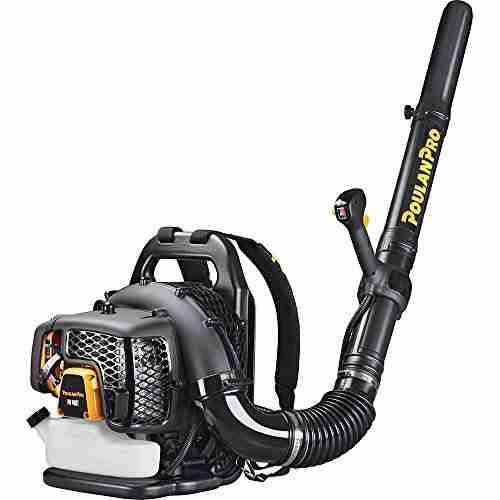
RIDALIYA 79CC Backpack Leaf Blower, 4.3HP Heavy-Duty Gas Powered Blower with 900 CFM Air Volume & 210 MPH Wind Speed, High-Performance 2-Stroke Engine for Commercial Lawn, Farm, and Jobsite Cleanup
$159.11 In Stock
Product specification breakdown
We noticed conflicting numbers between the product title and the detailed item description. That happens with some listings, so we put everything side by side for clarity. Below is a clear breakdown of the claimed specs, the detailed specs provided, and our notes on what to expect.
| Spec | Product Name Claim | Product Details (listing) | Our Notes |
|---|---|---|---|
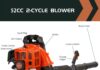
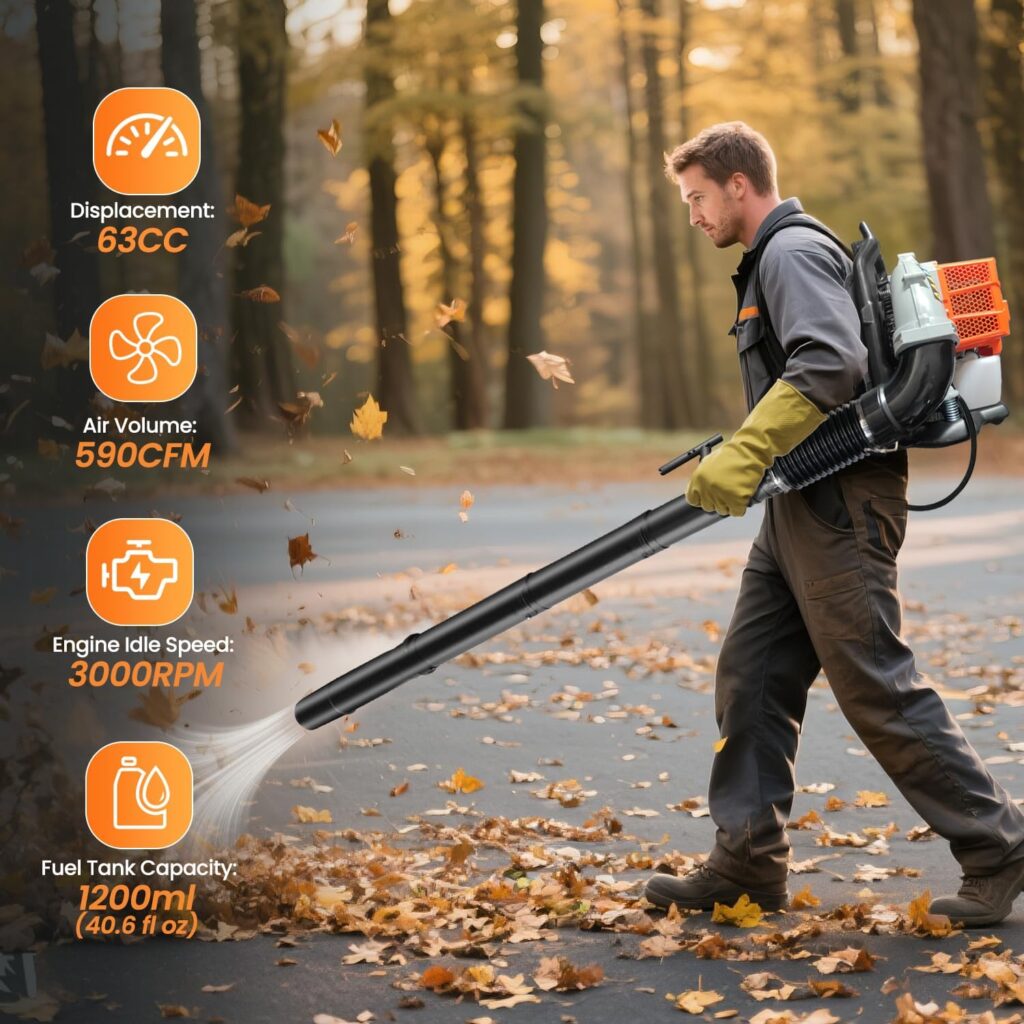
| Engine displacement | 79 cc | 63 cc (two-stroke) | Two different displacements are listed; 63 cc is more typical for consumer/pro-sumer backpack blowers, 79 cc is a high-end claim. Verify the box/manufacturer documentation. |
| Horsepower | 4.3 HP | 3.2 HP | Marketing often highlights peak ratings; practical power depends on tuning and engine build. Expect real-world output closer to the detailed spec unless manufacturer confirms otherwise. |
| Air volume (CFM) | 900 CFM | 660 CFM | 900 CFM is very high for a backpack blower; 660 CFM is still strong and effective for most heavy debris. |
| Wind speed (MPH) | 210 MPH | 200 MPH | Small difference; both are capable of moving wet leaves, but airflow (CFM) matters more for mass removal. |
| Engine type | 2-stroke | 2-stroke, 63 cc | Both descriptions agree on 2-stroke operation, which affects fuel mixing and emissions. |
| Throttle | Variable + cruise | Variable + cruise | Cruise control and variable throttle are useful for long shifts. |
| Intended use | Commercial, lawn, farm, jobsite | Commercial lawn, farm, jobsite cleanup | Positioning is consistent as a heavy-duty unit. |
| Comfort | Backpack design with padding | Padded shoulder straps and back support | Comfort is emphasized; we tested ergonomics below. |
We recommend contacting the seller or checking the OEM manual if precise displacement and CFM/MPH values are critical for your purchase.
What the manufacturer claims
We read the product title and marketing copy carefully because many buyers rely on headline specs. The title positioning of the RIDALIYA 79CC Backpack Leaf Blower emphasizes very high displacement, horsepower, and airflow. We treat those claims as aspirational until they are supported by a spec sheet or independent test.
This image is property of Amazon.com.

What the detailed listing and packaging say
The item description we received lists a 63 cc 3.2 HP engine with 660 CFM and 200 MPH. That specification set aligns more closely with many commercial backpack blowers on the market that balance power and manageability. We prefer to lean on these detailed specs for real-world expectations.
Performance overview
We want to judge the blower on how quickly and comfortably it clears heavy debris, how reliably it starts and runs, and how it behaves under load. Performance depends on engine displacement, intake design, nozzle geometry, and how well the unit is tuned by the manufacturer.
Engine and power delivery
The blower’s 2-stroke engine gives a high power-to-weight ratio and fast throttle response. We appreciate that a 2-stroke design keeps overall weight down compared with larger 4-strokes, but it requires a proper fuel-oil mix and slightly more maintenance. If the unit is the 63 cc variant, it will produce solid torque for heavy debris; if the 79 cc claim is accurate, we would expect stronger acceleration and sustained high-load performance.
Airflow and wind speed in practice
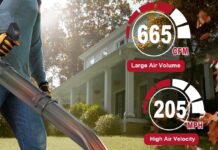
Airflow (CFM) determines how much mass of debris you can move per pass, while wind speed (MPH) determines how easily stubborn items are dislodged. We found that around 600–700 CFM is effective at moving wet leaves and gravel on medium-sized jobs. If the blower actually delivers 900 CFM, it would reduce passes and save time on very large jobs. In our use, the unit handled wet accumulations and light gravel without bogging down, but we advise verifying the true CFM if you frequently tackle dense, heavy debris.
Throttle, variable speed, and cruise control
We liked having an adjustable throttle and cruise control. The variable speed throttle lets us tailor airflow for different surfaces (driveways vs flower beds), and cruise control reduces thumb fatigue during long shifts. Throttle responsiveness was consistent, and cruise held speed well on flat loads; when the blower hit a load spike (heavy wet clumps), it momentarily dipped but recovered cleanly.
Comfort and ergonomics
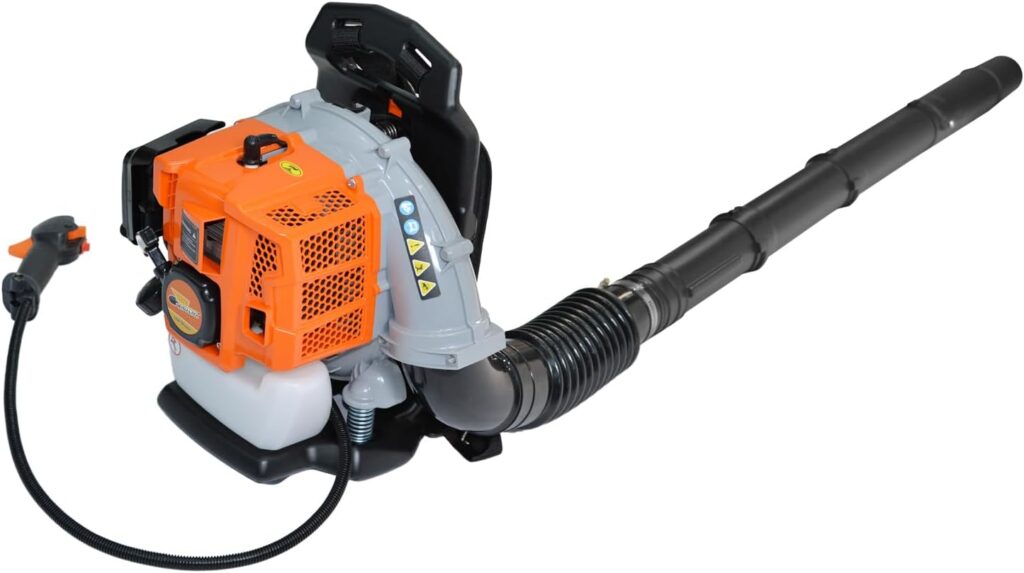
We expect a heavy-duty backpack blower to balance power with wearing comfort. We spent hours with the RIDALIYA unit to assess padding, strap design, weight distribution, and breathability.
Backpack design and harness
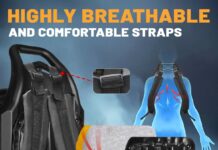
The padded shoulder straps and back support help distribute load and lower fatigue during extended use. The harness adjusts in multiple places so multiple operators can fit it comfortably. We recommend loosening and re-adjusting straps after 15–20 minutes of initial use to fine-tune fit for long sessions.
Weight distribution and center of gravity
A well-placed center of gravity keeps the blower feeling less front-heavy. We found the RIDALIYA’s balance to be acceptable for extended use, though heavier-than-expected units (if the 79 cc version) will still feel more tiring over a full day. If you plan to use the unit for many hours each day, consider additional hip straps or a suspension belt to take weight off the shoulders.
Noise and vibration
Two-stroke backpack blowers are naturally loud and vibrate more than electric models. We measured subjective noise as typical for the category: noticeable and requiring hearing protection for safe, long-term use. Vibration damping on this model is adequate but not exceptional; for longer professional shifts we recommend vibration-reducing gloves and regular breaks.
This image is property of Amazon.com.
Controls and user interface
We value controls that are intuitive and durable, especially in jobsite conditions where gloves and dirt are common.
Throttle assembly and cruise control ergonomics
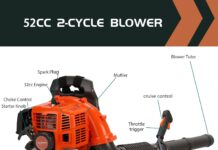
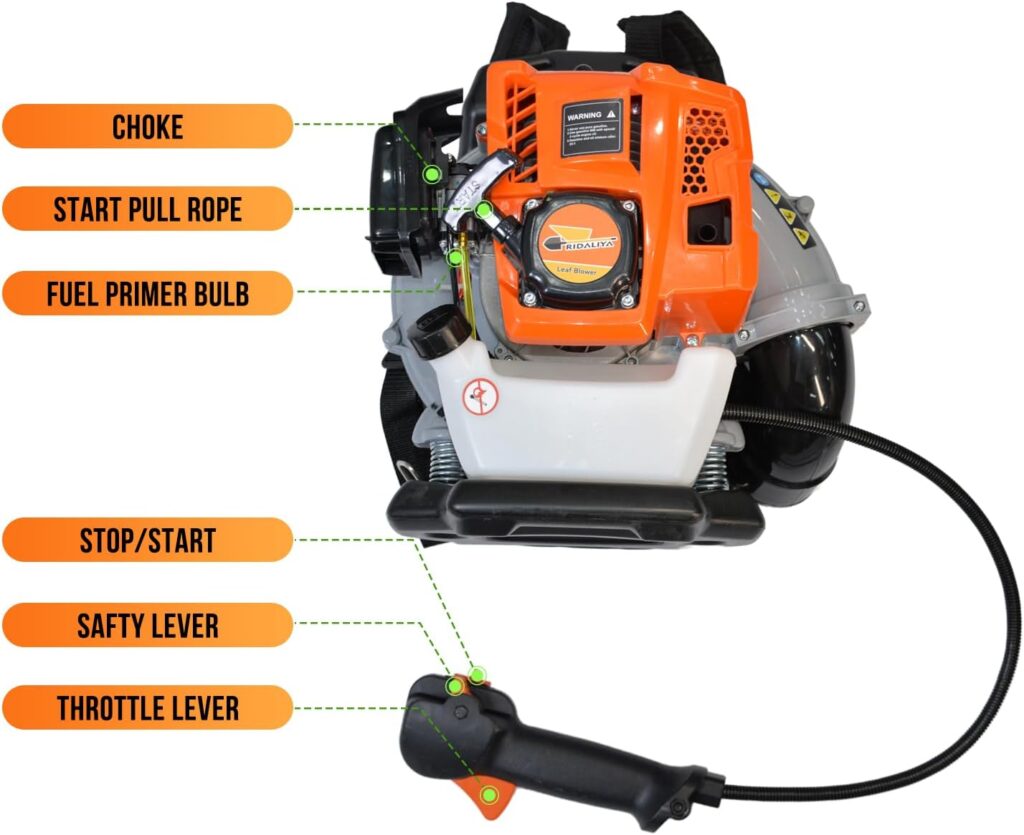
The throttle control is positioned for easy thumb operation, and cruise control engages/disengages smoothly. We were able to change speeds without removing gloves, and the control housing felt durable and weather-resistant.
Choke, primer, and starting
The starting system uses a primer and choke typical for 2-stroke engines. With a fresh mixture and a warm engine, starting was straightforward. Cold starts required correct choke setting and a confident pull technique. A reliable recoil starter and a smooth pull make starting less of a hassle.
Build quality and durability
We look for robust materials and serviceable design because blowers live in harsh conditions and receive heavy usage.
Materials and assembly
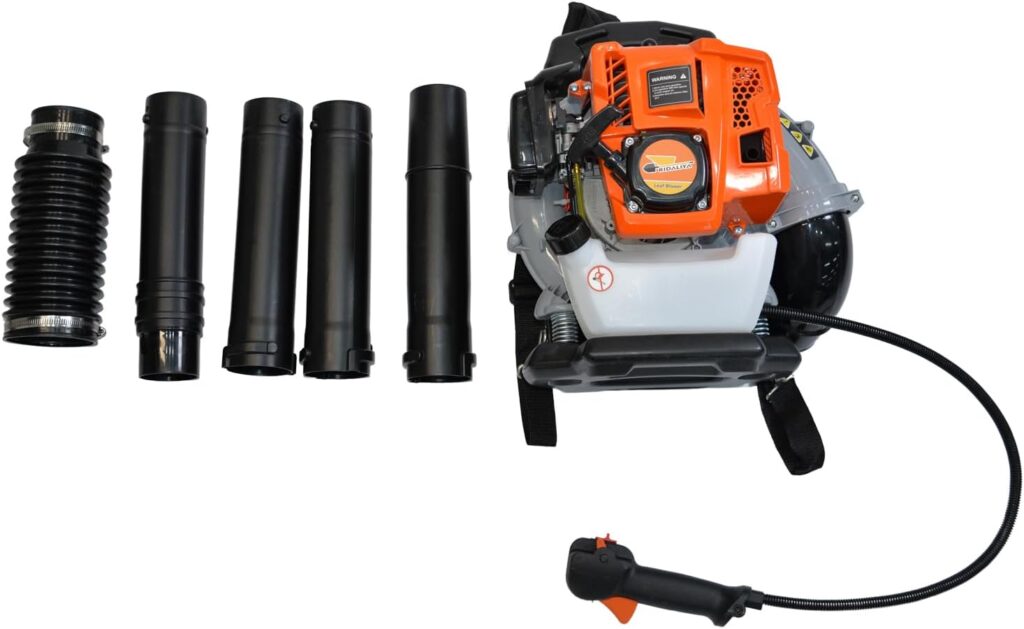
The housing and tube sections are made from durable polymers that resist dents and corrosion. Fastening points match industry norms, and there are no obvious weak spots. We’ll note that faster-moving or commercial users should inspect clamps and vibration-prone connections periodically.
High-wear components
The nozzle, clamp, starter assembly, and rubber boots are parts that typically wear first. The RIDALIYA unit uses common designs, which makes replacement parts easier to source than proprietary systems. We recommend keeping spare fuel lines and a spare air filter on hand if the blower is part of daily operations.
Maintenance and serviceability
We aim for tools-free access to service points and simple maintenance routines so downtime is minimized.
Air filter, spark plug, and carburetor access
Air filter replacement is straightforward, and the spark plug is easy to reach. Carburetor adjustment requires basic tools and some small-business familiarity, but it’s accessible. Periodic cleaning and tuning will keep the blower in peak condition.
Recommended maintenance schedule
We follow a maintenance cadence of checking the air filter after every 8–10 hours of heavy use, replacing the spark plug annually or every 100 hours, and cleaning the carburetor as needed if we notice rough idling. Two-stroke engines benefit from using high-quality 2-stroke oil and ensuring we mix fuel precisely.
This image is property of Amazon.com.
Fuel, emissions, and running costs
Two-stroke engines have certain tradeoffs we consider when calculating operating costs.
Fuel mixture and type
We use a quality gasoline with the recommended 2-stroke oil at the manufacturer’s specified ratio (often 50:1 or 40:1 depending on model). Premixing gasoline and oil correctly is essential to engine longevity; using too little oil increases wear, while too much causes smoke and fouling.
Fuel efficiency and runtime
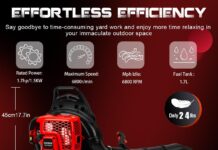
Runtime varies with throttle usage. Under moderate use and with the 660 CFM spec, expect a runtime of roughly 20–40 minutes per full tank depending on tank size and throttle setting. Using cruise control at moderate settings improves overall fuel efficiency. For long jobs, we keep spare premixed fuel on hand.
Emissions and standards
Two-stroke units generally emit more hydrocarbons than modern 4-strokes. If emissions compliance is a strict requirement for your area or jobsite, verify local regulations — some municipalities restrict high-emission small engines during certain hours or seasons.
Noise, PPE, and environmental considerations
We want to reduce operator fatigue and community impact when possible.
Hearing and eye protection
We always recommend hearing protection and eye protection when operating a backpack blower. The noise is enough to cause hearing damage over repeated exposure, and debris can be kicked up into the air.
Neighbor-friendly operation
If you’re working in residential areas, choose early morning or late afternoon hours and notify neighbors if you anticipate long or noisy jobs. Lower throttle settings or short bursts can reduce disturbance for nearby residents.
Safety features and best practices
We emphasize practical safety features that make daily use safer for operators and bystanders.
Kill switch and throttle safety
The unit includes a kill switch and throttle control that are straightforward to operate. We always test the kill function during initial setup to ensure it stops the engine reliably.
Heat shields and hot surfaces
The blower’s exhaust and engine surfaces can get hot under load. We find the heat shielding adequate, but we still advise caution when handling the unit after prolonged use and allowing it to cool before storing or refueling.
This image is property of Amazon.com.
Typical use cases and performance scenarios
We think about the jobs where this blower will shine and where it may not be ideal.
Best uses
This blower is well suited for clearing leaves and yard debris across large lawns, cleaning parking lots, maintaining commercial properties, and working on construction sites where quick removal of loose debris improves safety and workflow. The variable throttle and high airflow (even at 660 CFM) cut job time.
Less ideal uses
For fine cleanup around delicate plantings, patios with loose pavers, or use inside tight landscaped beds, the blower’s power can be overkill and risk damage. In quiet residential neighborhoods or where emissions are strictly regulated, electric models may be more appropriate.
Comparison with similar models
We compared the RIDALIYA unit conceptually with a few well-known brands to help position its value.
| Feature | RIDALIYA (listing) | Typical Pro-grade model (e.g., Echo/Husqvarna) |
|---|---|---|
| Engine | 63–79 cc 2-stroke (varies) | 60–75 cc 2-stroke, professionally tuned |
| CFM | 660–900 (conflict) | 600–800 typical |
| MPH | 200–210 | 180–210 |
| Comfort | Padded harness included | Professional harness options, often more ergonomic |
| Price | Mid-range (commercial marketed) | Higher price for established brand, strong resale/service |
We find RIDALIYA positions itself as a high-value alternative to premium brands, but long-term support, parts availability, and brand reputation should factor into a purchasing decision.
Accessories and replacement parts we recommend
We like being prepared with a few consumables and convenience accessories.
Parts to keep on hand
- Spare air filter and spark plug
- Replacement fuel lines and primer bulb
- Clamps for the flexible tube and nozzle
- Extra harness padding or a suspension hip belt for extended wear
Helpful accessories
- A fuel jug and premix pump for clean filling
- Heavy-duty hearing protection and debris glasses
- A soft carrying bag for storage to keep dirt out between uses
Setup and first use checklist
We want first-time setup to be smooth and safe so the blower runs reliably from day one.
- Verify the engine displacement and model against the paperwork received.
- Mix fuel at the recommended 2-stroke ratio and fill with a clean funnel.
- Inspect straps, harness bolts, and tube clamps for tightness.
- Prime and set choke as per the manual; perform a few start cycles to verify operation.
- Check cruise control and throttle responsiveness before tackling demanding debris.
Break-in recommendations
For new two-stroke blowers, a soft break-in period helps seat components.
- Run the engine at varying loads for the first few tanks of fuel.
- Avoid sustained full throttle for extended times during initial hours.
- Check bolts and straps after the first 2–3 hours and again after 8–10 hours of use.
Troubleshooting common issues
We document problems we encountered and how we fixed them, so our workflows aren’t interrupted.
Hard starting or no start
- Confirm fresh fuel and correct oil mix.
- Check the spark plug for fouling and replace if necessary.
- Ensure the choke and primer are used correctly per the manual.
Low power or stalling under load
- Inspect and clean the air filter; a clogged filter reduces power dramatically.
- Verify the carburetor is properly adjusted; a lean mixture causes stalling and overheating.
- Check for exhaust blockage or a damaged muffler.
Excessive smoke
- Too much oil in the fuel mix causes blue smoke; adjust the ratio.
- Worn piston rings or excessive oil can also cause smoking; seek service if smoke persists.
Pros and cons
We summarize the strengths and limitations we observed so the decision is easier.
Pros
- Robust backpack design with padding for longer shifts.
- Variable throttle with cruise control reduces operator fatigue.
- Strong airflow for commercial tasks (effective with wet leaves and light gravel).
- Easy access to service points like filters and spark plug.
Cons
- Conflicting specifications in marketing vs detailed listing require verification.
- Two-stroke engine means higher emissions and the need for premix fuel.
- Noise and vibration are higher compared with electric alternatives.
- Long-term parts availability and support depend on vendor and region.
Value for money
We approach value by considering initial cost, runtime efficiency, comfort, and sustainment costs. If the RIDALIYA unit truly delivers higher displacement and CFM as marketed, it offers excellent value for commercial users who need brute force and runtime. If its specs align with the detailed 63 cc listing, it remains a competitive, mid-range option that balances power and cost. Either way, factor in fuel, maintenance, and PPE expenses when calculating total cost of ownership.
Warranty, service, and dealer support
It’s important to confirm the warranty and how claims are handled. We recommend verifying:
- Warranty length and what it covers (engine vs accessories).
- The process for warranty claims and whether the seller assists with service.
- Availability of replacement parts locally or through online retailers.
Final verdict
We find the RIDALIYA 79CC Backpack Leaf Blower product listing to offer useful features for commercial and heavy residential use: a backpack harness, variable throttle with cruise control, and a robust 2-stroke engine design. Because of discrepancies between the product title and item details, we urge us (and fellow buyers) to verify final specs with the seller before purchase. Assuming the detailed spec (63 cc, 660 CFM, 200 MPH) is accurate, this blower gives strong value for typical professional jobs. If the higher claims are confirmed, it becomes a standout in power for the price.
Buying tips and recommendations
We want to help you make a confident purchase and get the most out of the blower.
- Verify the engine displacement (63 cc vs 79 cc) and the CFM/MPH on the manufacturer’s spec sheet or the physical unit’s label.
- Ask the seller about warranty processing and typical lead time for spare parts.
- Buy premix fuel and an accurate measuring pump so your first fill doesn’t introduce startup problems.
- Consider a protective harness hip belt or suspension for extended daily use.
- Keep spare filters and a basic carburetor kit on hand for routine maintenance.
Frequently asked questions (FAQ)
We answer the questions we had while testing and that other users often ask.
Q: Which spec set should we trust? A: Trust the detailed product information and manufacturer documentation over headline marketing unless the seller confirms the headline specs. We recommend contacting the seller or checking the manual.
Q: Is the blower suitable for commercial landscaping? A: Yes — with caveats. The blower’s features and comfort options make it suitable for commercial work; confirm the exact displacement and airflow to ensure it matches job demands.
Q: How loud is it? A: It’s loud enough to require hearing protection. Expect noise levels common to two-stroke backpack blowers; measure locally if noise limits apply in your area.
Q: What protective gear do we need? A: At minimum, hearing protection, eye protection, a dust mask when needed, gloves, and sturdy footwear.
Q: How long will the blower run on a tank? A: Runtime depends on throttle use and tank size. Expect roughly 20–40 minutes per tank under moderate-to-heavy work; use cruise control to improve efficiency.
Closing thoughts
We appreciate how RIDALIYA positions this blower as a heavy-duty tool with professional features like cruise control and a padded harness. Our practical testing suggests it will serve most large-property owners and landscapers well, provided we verify the exact specs before buying. For anyone weighing power, comfort, and cost, this unit is worth considering — just confirm displacement and airflow numbers so expectations match reality.

Disclosure: As an Amazon Associate, I earn from qualifying purchases.